
Your route begins at the address confirmed in writing.
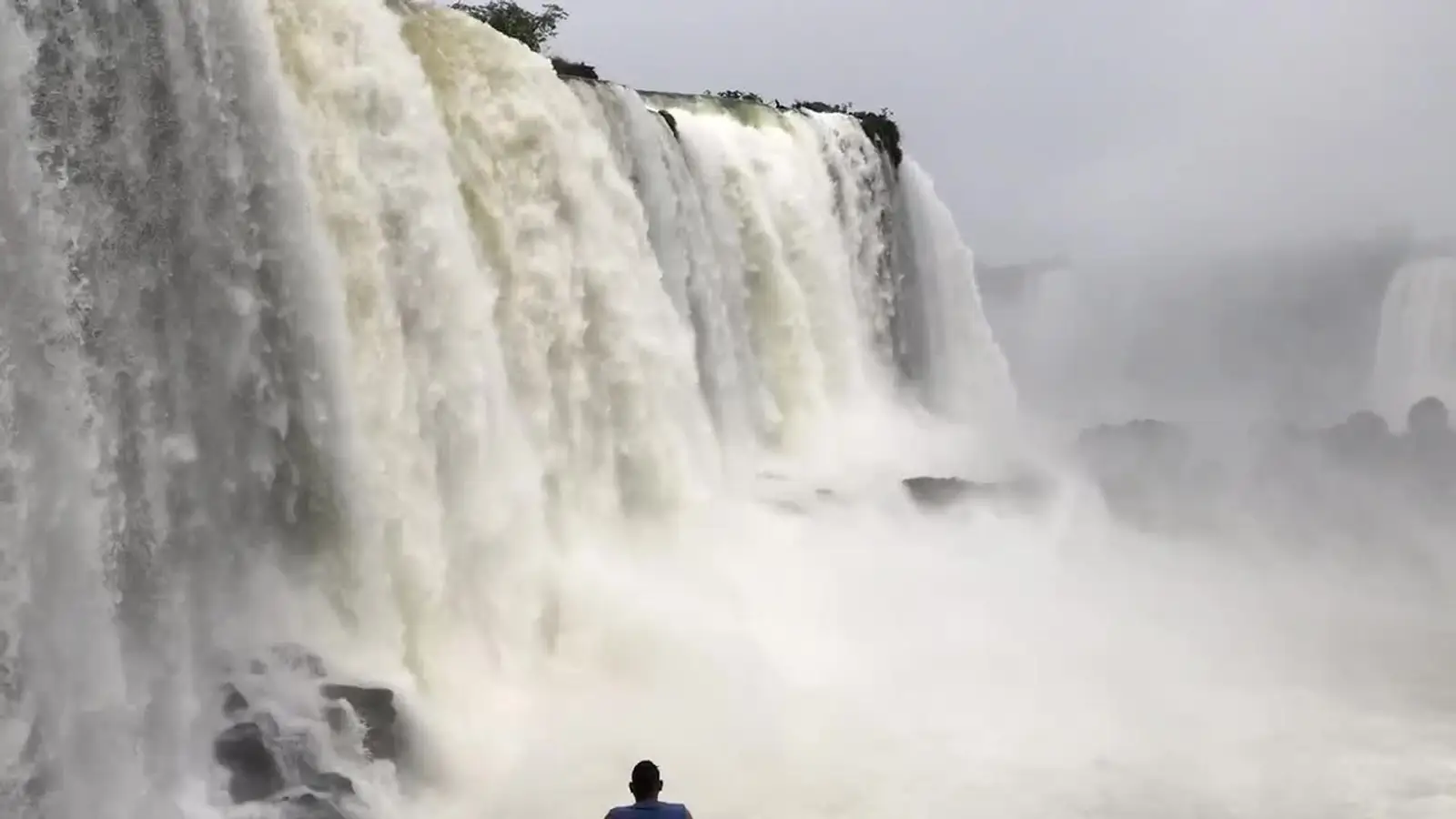
Brazil · Iguaçu National Park · panoramic trail
Iguazu Falls Brazilian side
Walk through Atlantic Forest viewpoints until the trail steps into the spray facing Devil’s Throat — with live river context and prices drawn from our database.
River now4,425,000 L/sVery high flow · station 65992502
Brazilian-side panorama · filmed on our tours
The answer first
Is the Brazilian side of Iguazu Falls worth it?
Yes — the Brazilian side is the best single panoramic reading of Iguazu Falls.
You spend less time changing circuits and more time watching the scale assemble itself: distant curtains first, then wider ledges, then the final encounter with Devil’s Throat. It complements rather than duplicates Argentina.
- Trail character
- Panoramic, point-to-point viewpoints
- Main trail
- About 1.2 km / 0.75 mi
- Signature moment
- Walkway facing Devil’s Throat
- Typical park visit
- Allow roughly half a day
- Waterfalls in the system
- About 275, varying with river flow
- Tallest drops
- Around 80 m / 260 ft
- UNESCO World Heritage
- Iguaçu National Park, listed 1986
- Country
- Brazil
Park tickets follow nationality
Complete the same day — transfer already included
Your day, measured
- Vehicle for 2 travellersPrivate sedan or SUV · 1–3 travellers
- Private vehicle + English-speaking guide$197.27
- Park admission · 2 people$61.29
- Macuco Safari (boat under the falls) · tickets$147.09
Estimated total$405.64
Set in Brazilian reais from our live database; converted at the ECB reference rate of 2026-10-02. Vehicle is per group, tickets are per person. Your written quote confirms everything before you pay anything.
Send this plan on WhatsAppA 1.2 km reveal
What happens along the Brazilian-side trail?
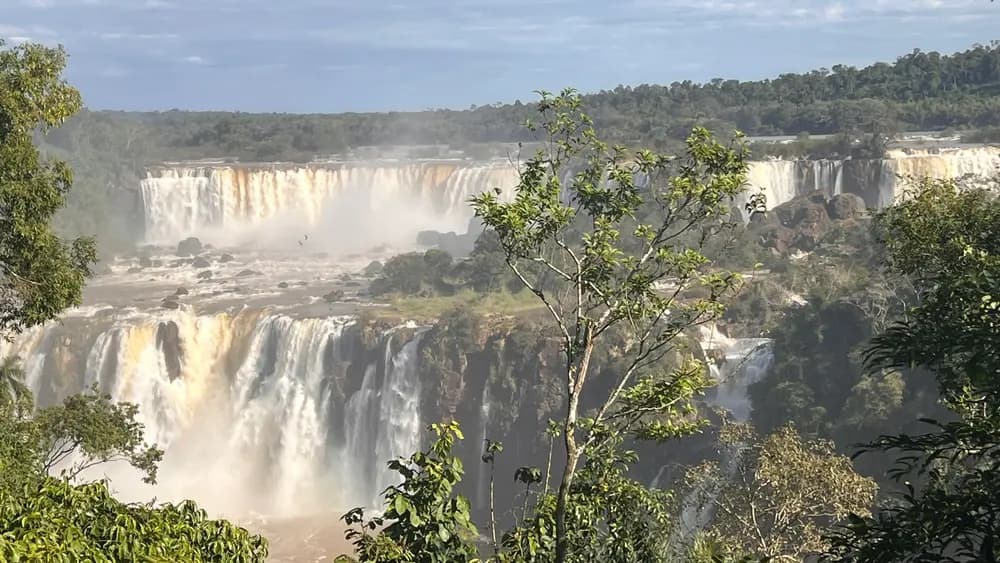
The route reveals the falls in stages, moving from framed forest views to the open spray of Devil’s Throat.
- 01 · First overlookThe opposite cliffs establish the full width of the system.
- 02 · Forest windowsShort viewing breaks alternate with shaded Atlantic Forest.
- 03 · Water at eye levelThe trail drops and individual curtains feel progressively closer.
- 04 · The final walkwayOpen water, rising spray and the strongest view toward Devil’s Throat.
- 05 · Upper viewpointThe last elevation gathers river, gorge and multiple falls into one frame.
Choose the viewpoint, not a winner
How does Brazil compare with the Argentinian side?
Brazil is panoramic and compact; Argentina is immersive and normally requires a full day.
| Decision | Brazil | Argentina |
|---|---|---|
| Core experience | Wide panorama | Among and above falls |
| Time to reserve | Roughly half a day | Normally a full day |
| Signature moment | Final spray walkway | Multiple circuits |
| Walking pattern | One main 1.2 km trail | Several circuits |
| Best plan | Visit both on separate days | |
Live instrument · updated hourly
How much water is flowing at Iguazu Falls right now?
The latest public station reading is 4,425 m³/s, or 2.9× the 1,500 m³/s historical reference.
Flow changes the roar, spray and how individual curtains read. It does not predict access: the park operator makes operational decisions.
Live telemetry4,425m³/s · ANA/Copel 65992502▼ easing · 10.0% vs 24h
No hidden number
How much are Iguazu Falls Brazil tickets?
The current foreign-visitor adult entry in our database is R$160 (about US$30 · €27 at the 2026-10-02 ECB reference rate); with a Brazilian document it is R$121.
| Item | How it is priced | Current display |
|---|---|---|
| Park admission | Per person · foreign visitor | R$160US$30 · €27 |
| Park admission | Per person · Brazilian document | R$121US$23 · €20 |
| Child admission | Free under 7 · Ages 7+ pay the adult price | Confirmed in quote |
| Private vehicle | Per vehicle / group | Written quote |
| English-speaking guide | Per group | Written quote |
BRL is canonical. Currency conversion is informational; your dated written quote confirms every amount.
Read conditions, not myths
When is the best time to visit the Brazilian side?
The best time is the dated entry that fits your full itinerary, weather and current park operation.
Morning often gives a clean planning window, but light, crowds and spray vary. Higher flow usually means more mist and visual force; lower flow can reveal more rock and separate curtains. We confirm the current park timetable before a written itinerary.
One vehicle · your pace
How do we visit the Brazilian side with you?
We build a private, written plan around your hotel, group size and the rest of your Iguazu itinerary.
Context and logistics without turning the trail into a lecture.
We align dated park access with the day’s wider route.
Prepare for water
What should you bring to Iguazu Falls Brazil?
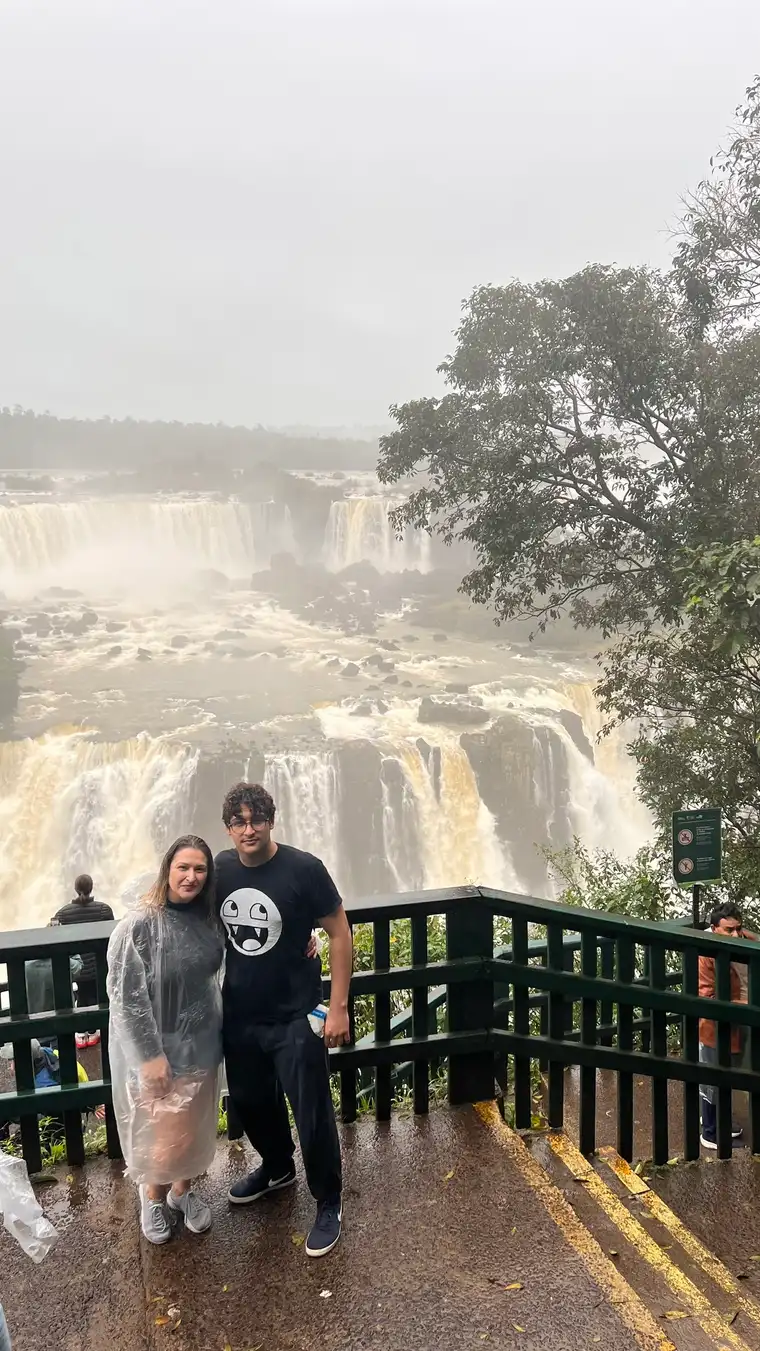
Bring secure walking shoes, sun protection, water and a light waterproof layer for the final spray.
- Keep phones and passports in a sealed pouch.
- Choose shoes with grip; surfaces can be wet.
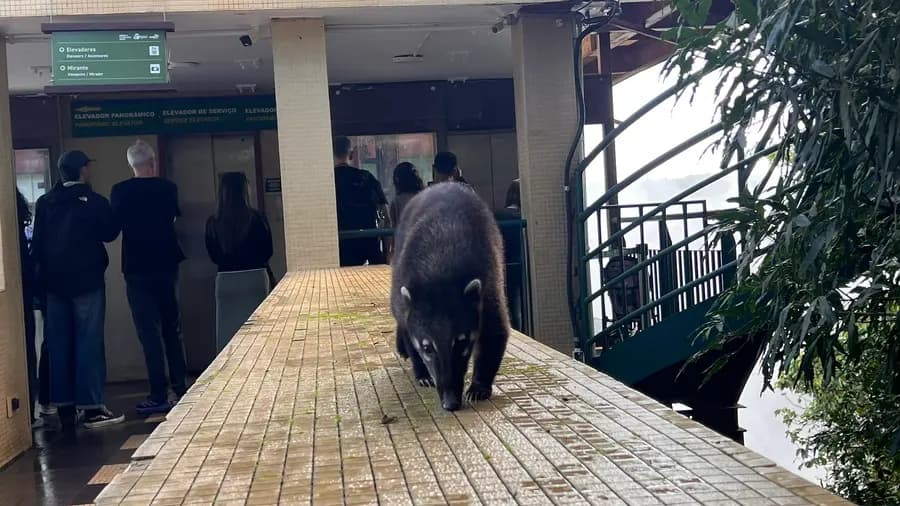
- Carry only what you can keep close around wildlife.
- Use reef-safe sunscreen and refillable water where practical.
Beyond the walkway
What can you combine with the Brazilian side?
Bird Park, Macuco Safari and a helicopter flight are the closest common additions, subject to time, weather and availability.
We place extras around the falls rather than compressing the falls around extras. The Home itinerary and calculator show how each option fits without inventing pages or promises.
The helicopter flight over the falls has its own guide: price per seat, the boarding rules that decide whether you fly, and why it departs only from this side of the river.
Filmed on our own visits
See the Brazilian side before you walk it
Sixteen minutes, fourteen chapters and the full transcript: the trail, the walkway and the elevators, the helicopter flight and the Macuco Safari boat.
 16 MIN · NARRATED
Iguazu Falls Brazil Side: what to expect (walkway, helicopter, boat)Filmed on our own visits · 16 min
Read the transcript
0:02 Welcome to one of the most breathtaking wonders of our planet: Iguazu Falls, on the border between Brazil and Argentina.
0:09 In this video we explore the Brazilian side of the falls, where panoramic views, adventure and the Atlantic rainforest come together.
0:24 The falls sit inside Iguaçu National Park, a UNESCO World Heritage Site. Established in 1939, the park protects over 185,000 hectares of Atlantic rainforest,
0:40 one of the last sanctuaries for jaguars, tapirs, toucans and countless butterflies.
0:52 On the Brazilian side, the experience is about perspective. Argentina has more trails close to the water; Brazil offers the sweeping panoramic view.
0:59 From here you can admire more than 275 individual waterfalls spread across nearly 2 miles of the Iguaçu River.
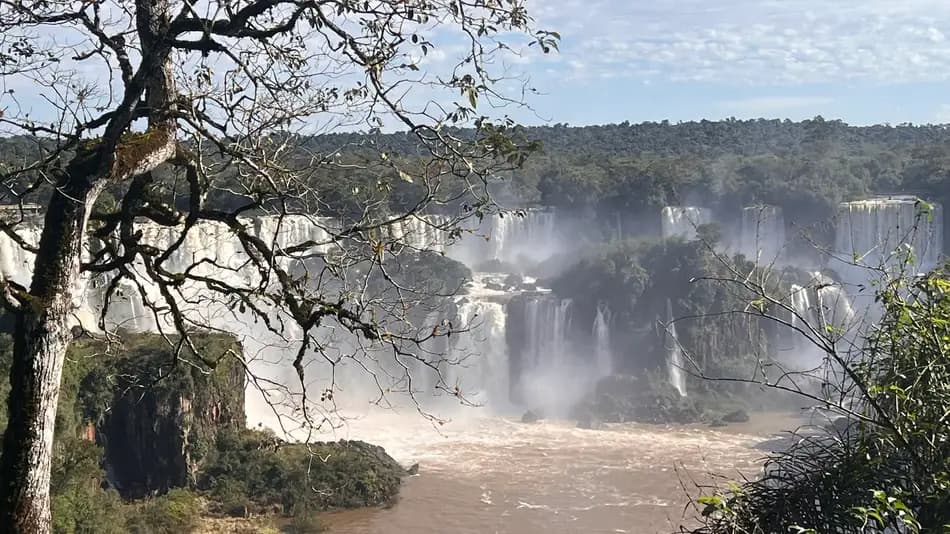
1:16 The river changes with the season. After heavy rain the water turns a rich brown, carrying clay and sediment from upstream.
1:25 In drier months it shifts to a lighter, almost emerald tone. Each visit shows a different personality of the falls.
2:06 Iguazu Falls offers complementary experiences on both sides. The Argentine side, home to more than 80% of the falls, brings you very close to the water on trails and walkways.
2:23 The Brazilian side opens up to wide panoramic viewpoints that reveal the whole complex. There isn't a prettier side: they are perspectives that complete each other.
3:02 The main panoramic trail on the Brazilian side is about 1 mile long, with several viewpoints along the way.
3:14 The highlight is the walkway that extends over the river to a platform facing the Devil's Throat, the most powerful section of the falls.
4:02 The Devil's Throat is a massive U-shaped cliff where millions of liters of water crash down every second, producing mist so intense that rainbows appear often.
4:26 The walkway is one of the most iconic highlights of the Brazilian side: it stretches toward the heart of the falls and lets you feel the power of the water and the rising mist.
4:43 Access is through well-structured trails with several viewpoints. Visitors with reduced mobility or wheelchairs can go directly to the walkway by panoramic elevators,
5:06 so people of all ages and physical conditions can enjoy the falls in comfort and safety.
5:36 The helicopter flight over the falls is one of the most thrilling experiences here: a panoramic view of the national park, the river winding through the forest and the waterfalls.
5:54 The flight usually lasts between 10 and 15 minutes. From the sky you see the vastness of the falls, the mist dissolving into clouds and, on sunny days, full rainbows over the canyon.
6:36 Back on the ground, another option is the Macuco Safari. It begins with an electric vehicle ride through the forest and a short walk down a trail;
6:44 then you board speedboats that race upriver to the base of the falls. Be prepared to get completely soaked.
7:09 After so much adventure, the Porto Canoas restaurant awaits by the river, with views of the Iguaçu just before it plunges over the edge.
7:43 The park also offers exclusive experiences like the sunrise at the falls (Amanhecer nas Cataratas): before opening hours, small groups enter with a guide to watch the first light on the waterfalls.
8:32 The sunset at the falls (Entardecer nas Cataratas) shows the cascades under the warm colors of the setting sun. Both are limited to small groups.
8:55 Wildlife encounters are common: coatis near the trails, colorful butterflies and the calls of birds in the forest.
9:29 The Brazilian side blends adventure and perspective: panoramic trails, helicopter flights, boat rides and sunrise or sunset tours.
9:56 The average flow of the falls is about 1.5 million liters of water per second, but it varies a lot with rainfall and the level of the Iguaçu River.
10:13 A remarkable example was June 2014, when the flow reached around 40 million liters per second, one of the highest volumes ever recorded; some walkways had to be closed for safety.
10:38 During floods the water color changes too: normally greenish, it takes on brown, earthy tones as the current carries sediment, clay and organic matter.
11:14 The rainbow at Iguazu Falls is a spectacle of its own, formed when sunlight meets millions of droplets suspended in the air by the power of the water.
11:37 Depending on where you stand and the light, you may see a single arc, a double rainbow or shifting fragments of color with every step.
12:30 (Falls footage, no narration)
15:53 Thank you for joining us on this journey through Brazil's side of Iguazu Falls. Subscribe for more practical travel guides. Until next time, keep exploring.
From gate to gorge
How does the Brazilian-side visit actually work?
Think of the visit as four clear movements: arrive, transfer through the forest, walk the panorama and return from Porto Canoas.
- 01Visitor Centre
Enter with your dated ticket and follow the boarding instructions for the park’s internal transport.
- 02Forest transfer
The included transport crosses the protected area to the traditional falls route.
- 03Panoramic trail
Successive overlooks build toward the final walkway and Devil’s Throat viewpoint.
- 04Porto Canoas
Use the lift, viewpoints and visitor facilities before boarding the return transport.
Different bodies · one panorama
Is the Brazilian side accessible for visitors with reduced mobility?
The park provides accessible transport and principal viewpoints, but the full traditional trail includes stairs and uneven sections.
Official guidance recommends Porto Canoas for visitors who want to avoid the complete walking route. From there, a panoramic lift connects with the final walkway area. Conventional wheelchairs can be requested free of charge at the Visitor Centre, subject to availability.
A calmer route
- Ask for assistance at the Visitor Centre
- Use the accessible internal transport
- Continue to the Porto Canoas stop
- Use the panoramic lift for the final viewpoint area
Know what is inside
What facilities are available inside the park?
The essential visitor structure is concentrated at the entrance and Porto Canoas, so you can plan breaks without interrupting the waterfall sequence.
Internal transport
Regular admission includes the park transfer between the Visitor Centre and the falls route.
Food and water
Food and drink points operate at the Visitor Centre and Porto Canoas; check the official guide for current availability.
Restrooms and pauses
Plan facilities around the main visitor hubs rather than expecting them at every forest viewpoint.
Wildlife care
Keep food secured, remain on marked paths and never feed or touch coatis.
Field cards · same source as schema
What do travellers ask before visiting Iguazu Falls Brazil?
Select a question to reveal the practical answer.
01Is the Brazilian side of Iguazu Falls worth it?
Yes. The Brazilian side is the clearest single panorama of the waterfall system and ends with a close, wet view toward Devil’s Throat.
02How long do you need on the Brazilian side?
Plan roughly half a day for transport inside the park, the 1.2 km trail, viewpoints and the final platform without rushing.
03Do you get wet on the Brazilian side of Iguazu Falls?
Usually, yes. Wind carries heavy spray across the final walkway, and the amount changes with river flow and weather.
04Which side of Iguazu Falls is better?
Neither side replaces the other: Brazil gives the broad panorama, while Argentina places you among and above individual falls.
05Can you visit both sides of Iguazu Falls in one day?
It is technically possible on some dates, but we recommend one day per country so border time and park logistics do not erase the experience.
06What should you bring to the Brazilian side?
Bring secure walking shoes, sun protection, drinking water and a light rain layer or poncho for the spray.
07Do I need to buy Iguazu Falls Brazil tickets in advance?
Advance booking is the safer plan because park access uses dated entry slots and availability can change.
08Is the Brazilian side wheelchair accessible?
The park provides accessible internal transport and access to its principal viewpoints. Visitors who wish to avoid the trail stairs can continue to Porto Canoas for the panoramic lift and final walkway area.
09Is transport inside Iguaçu National Park included?
Yes. Regular admission includes the internal round-trip transport between the Visitor Centre and the falls area; private cars do not circulate freely inside the protected area.
10Are there places to eat inside the Brazilian park?
Yes. Food and drink options are available at the Visitor Centre and around Porto Canoas, near the end of the traditional falls route. Operations can change, so confirm on the official park website for your date.
Content reviewed August 20, 2026 · prices & river data refresh hourly
Ready to turn the panorama into a plan?
Tell us your dates and group size; we will return a written itinerary and a fixed quote before you pay anything.
Plan the Brazilian sideOr write to the field desk
Tell us the trip — we reply in writing
dispatch
ready
ready
0%