Key answers
- The Brazilian side of Iguazu Falls is the panoramic side: a 1-mile trail with viewpoints and a walkway over the river facing the Devil's Throat. Most visitors need 2 to 3 hours.
- It is inside Iguaçu National Park (UNESCO World Heritage Site, 1986), in Foz do Iguaçu, Brazil, about 20 minutes from the city and the airport.
- Optional extras on the Brazilian side: Macuco Safari boat ride, helicopter flight (about 10 minutes of flight), sunrise and sunset small-group tours.
- Accessibility: panoramic elevators take visitors with reduced mobility directly to the walkway.
- Brazil or Argentina? They complement each other: Brazil for the wide view, Argentina for walking close to the water. Most travelers do both, one day each.
Chapters
- 01Iguazu Falls, Brazil side: what this video covers
- 02Iguaçu National Park, UNESCO site
- 03Brazil vs Argentina: two perspectives
- 04The panoramic trail and the walkway
- 05Walkway, elevators and accessibility
- 06Helicopter flight over the falls
- 07Macuco Safari boat ride
- 08Porto Canoas restaurant
- 09Sunrise and sunset tours
- 10Wildlife on the trails
- 11River flow and water color
- 12Rainbows at the falls
- 13Just the falls: no narration
- 14Wrap-up
Full transcript
Welcome to one of the most breathtaking wonders of our planet: Iguazu Falls, on the border between Brazil and Argentina.
In this video we explore the Brazilian side of the falls, where panoramic views, adventure and the Atlantic rainforest come together.
The falls sit inside Iguaçu National Park, a UNESCO World Heritage Site. Established in 1939, the park protects over 185,000 hectares of Atlantic rainforest,
one of the last sanctuaries for jaguars, tapirs, toucans and countless butterflies.
On the Brazilian side, the experience is about perspective. Argentina has more trails close to the water; Brazil offers the sweeping panoramic view.
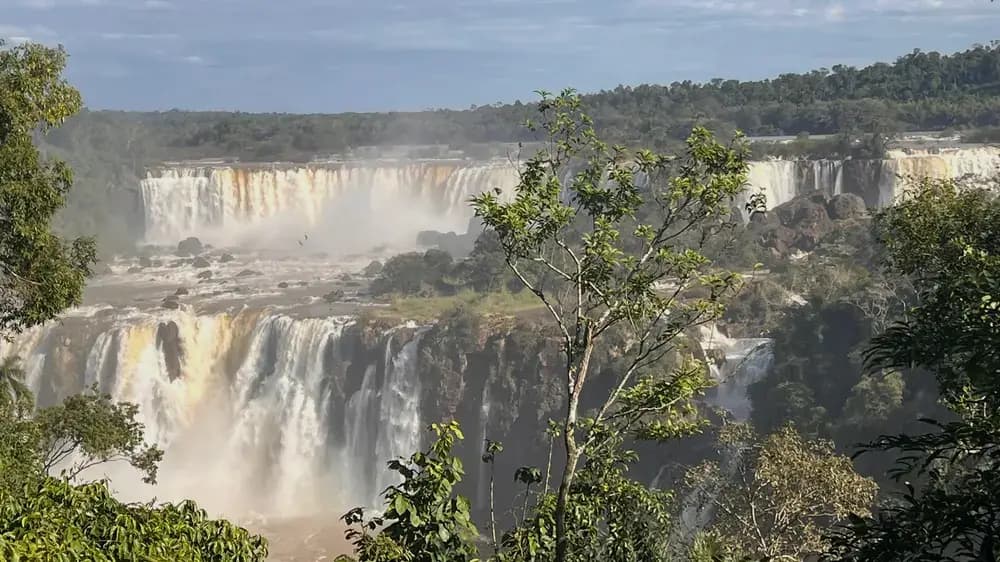
From here you can admire more than 275 individual waterfalls spread across nearly 2 miles of the Iguaçu River.
The river changes with the season. After heavy rain the water turns a rich brown, carrying clay and sediment from upstream.
In drier months it shifts to a lighter, almost emerald tone. Each visit shows a different personality of the falls.
Iguazu Falls offers complementary experiences on both sides. The Argentine side, home to more than 80% of the falls, brings you very close to the water on trails and walkways.
The Brazilian side opens up to wide panoramic viewpoints that reveal the whole complex. There isn't a prettier side: they are perspectives that complete each other.
The main panoramic trail on the Brazilian side is about 1 mile long, with several viewpoints along the way.
The highlight is the walkway that extends over the river to a platform facing the Devil's Throat, the most powerful section of the falls.
The Devil's Throat is a massive U-shaped cliff where millions of liters of water crash down every second, producing mist so intense that rainbows appear often.
The walkway is one of the most iconic highlights of the Brazilian side: it stretches toward the heart of the falls and lets you feel the power of the water and the rising mist.
Access is through well-structured trails with several viewpoints. Visitors with reduced mobility or wheelchairs can go directly to the walkway by panoramic elevators,
so people of all ages and physical conditions can enjoy the falls in comfort and safety.
The helicopter flight over the falls is one of the most thrilling experiences here: a panoramic view of the national park, the river winding through the forest and the waterfalls.
The flight usually lasts between 10 and 15 minutes. From the sky you see the vastness of the falls, the mist dissolving into clouds and, on sunny days, full rainbows over the canyon.
Back on the ground, another option is the Macuco Safari. It begins with an electric vehicle ride through the forest and a short walk down a trail;
then you board speedboats that race upriver to the base of the falls. Be prepared to get completely soaked.
After so much adventure, the Porto Canoas restaurant awaits by the river, with views of the Iguaçu just before it plunges over the edge.
The park also offers exclusive experiences like the sunrise at the falls (Amanhecer nas Cataratas): before opening hours, small groups enter with a guide to watch the first light on the waterfalls.
The sunset at the falls (Entardecer nas Cataratas) shows the cascades under the warm colors of the setting sun. Both are limited to small groups.
Wildlife encounters are common: coatis near the trails, colorful butterflies and the calls of birds in the forest.
The Brazilian side blends adventure and perspective: panoramic trails, helicopter flights, boat rides and sunrise or sunset tours.
The average flow of the falls is about 1.5 million liters of water per second, but it varies a lot with rainfall and the level of the Iguaçu River.
A remarkable example was June 2014, when the flow reached around 40 million liters per second, one of the highest volumes ever recorded; some walkways had to be closed for safety.
During floods the water color changes too: normally greenish, it takes on brown, earthy tones as the current carries sediment, clay and organic matter.
The rainbow at Iguazu Falls is a spectacle of its own, formed when sunlight meets millions of droplets suspended in the air by the power of the water.
Depending on where you stand and the light, you may see a single arc, a double rainbow or shifting fragments of color with every step.
(Falls footage, no narration)
Thank you for joining us on this journey through Brazil's side of Iguazu Falls. Subscribe for more practical travel guides. Until next time, keep exploring.
This is what is said in the video, transcribed as spoken.
Questions this video answers
Can you see the Devil's Throat from the Brazilian side?
Yes, from the walkway platform at the end of the trail, from a distance. On the Argentine side you walk over it (check the current status of that walkway before you go).
Does the water flow change what you see?
A lot. The average flow is around 1,500 m³/s; after heavy rain the river turns brown and the falls grow, and some walkways may close for safety. In dry months the water is greener and calmer.
Are there sunrise or sunset tours at the Brazilian falls?
Yes. The park runs two small-group experiences with a guide: Amanhecer nas Cataratas, which enters before opening hours to watch the first light on the water, and Entardecer nas Cataratas, which shows the cascades under the colours of the setting sun. Both are limited to small groups.
What wildlife do you see on the Brazilian side trail?
Coatis near the trails, colourful butterflies and forest birds you usually hear before you see. The trail runs through Atlantic rainforest inside a national park, so the encounters are wild and unpredictable rather than part of an exhibit.
More questions about planning the visit are answered on the Brazilian side guide.
Honest notes
footage from our own visits; conditions (water flow, weather, closures) change, so always check the official park channels for your date. We do not quote prices in videos, because they change; current prices are on our site.
Official sources
Plan this with us
Prices, opening hours and what is included are kept up to date on the Brazilian side guide — that is where the live numbers are. Tell us your dates and group size and we return a written itinerary and a fixed quote before you pay anything.